Tape Storage: From the 1950s to Today — Alive and Well
Magnetic tape has been part of computing since the 1950s, and despite repeated predictions of its demise, it continues to evolve and thrive.
(For background, see Tape drive – Wikipedia)
I’ve personally been using tape technology for around 20 years.
It started with a Travan TR-4 tape drive (Travan – Wikipedia) — which, believe it or not, you can still buy today. From there I moved on to DDS, then DLT, and today we run LTO.
In the early days, tape was commonly used for daily backups on small systems. That made sense at the time: disk storage was expensive, slow, and limited. Today, modern disk systems are extremely fast and dense, so disk is generally the right choice for first-line backups. However, as storage grows into the tens or hundreds of terabytes (and beyond), tape becomes compelling again.
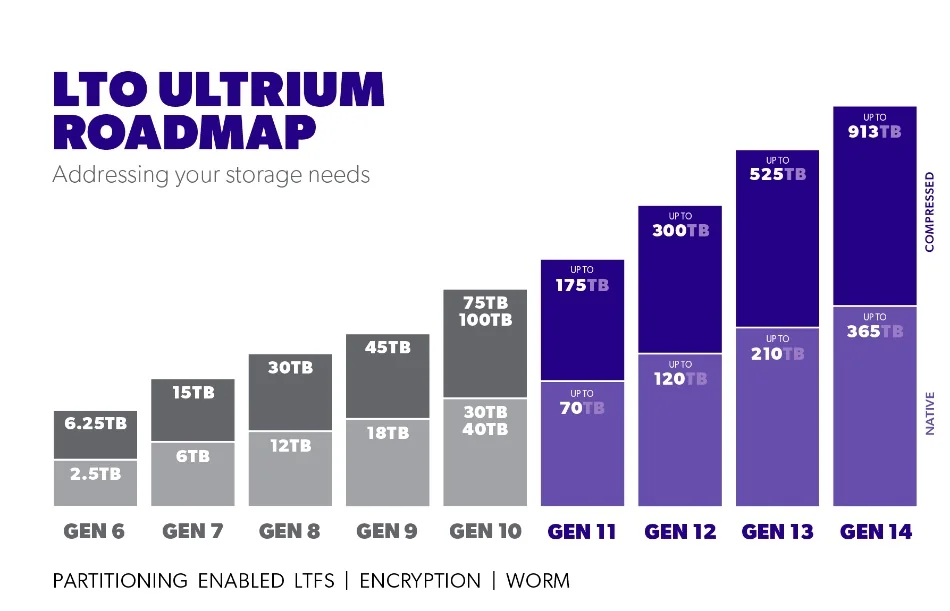
With the latest generations of LTO technology, a single tape now holds 18 TB native. When combined with an autoloaded or robotic library, you can scale very quickly — from 9 to 80+ tapes in a single unit, ranging from roughly 162 TB to well over 1 PB, with minimal power, cooling, or rack space requirements.
The LTO roadmap continues to aggressively increase capacity. Future generations are expected to reach hundreds of terabytes per tape. Given the physical length of LTO media, tape density may ultimately surpass spinning disk.
Tape storage isn’t just surviving — it’s actively being adopted for modern workloads, including AI and research archives. The reason is simple: cost, power efficiency, and density.
Stephen Bacon, VP, Data Protection Solutions Product Management, HPE, said:
“AI has turned archives into strategic assets. The new 40 TB LTO-10 cartridge will help enterprise-class organizations – across healthcare, financial services, media, research, manufacturing, the public sector, and beyond – consolidate petabytes efficiently, strengthen cyber resiliency with true offline air-gapping, and keep long-term retention affordable and sustainable.”
At Dataforge, tape is used as an addition to our backup service, not a replacement. Our primary storage systems are ZFS-based, and we can stream entire storage pools directly to tape at any time. This gives our customers ultra-long retention and true air-gapped security against ransomware and catastrophic events.
This approach complements our broader storage strategy outlined here:
Dataforge Storage Solutions
Need to keep massive amounts of video data forever? No problem. As your 4K and 8K video libraries grow, you simply add more tapes — without redesigning your storage infrastructure. Once you get into big data, tape removes many of the challenges associated with constant data growth.
Tape advantages include:
- High speed — tape writes data in a continuous stream, enabling both large capacity and high throughput.
- No power draw at rest — stored tapes consume zero power.
- True air-gap — data is physically disconnected from the network.
- Massive scalability — rapid growth without expanding your IT footprint.
- Reliability — I’ve never lost an LTO tape, including tapes over 15 years old.
- Easy off-site storage — older tapes can be moved into long-term storage.
- Read-after-write verification — LTO drives verify data immediately as it is written.
- Built-in encryption — modern LTO drives support hardware encryption and should always be used for removable media.
Tape does have nuances. It works best when the dataset is large, the storage system feeding the tape is fast, and data can be streamed continuously. Tape does not like to slow down — an LTO-9 drive can easily write at around 400 MB/s. Proper software is also required to index and track what is stored on each tape.
Tape isn’t legacy — it’s specialized.
If your business is dealing with rapidly growing data, long-term retention requirements, regulatory needs, or large video and research datasets, tape may be exactly what you need. If you’d like help evaluating your storage strategy, Dataforge can review your use case and determine whether modern LTO tape is a good fit.
If you simply want the air-gapped feature of tape, use our offsite backup services.
Dataforge Veeam Backup Services
Post Images
Click to view larger