Deals often slow down or stall when a business can’t show documented IT risk management, even before any security incident occurs. Insurers and partners now expect proof of process up front, which means missed opportunities and higher costs can arrive long before a breach.
A contract can stall for a reason that has nothing to do with price, service quality, or even trust between the two companies negotiating it: one side simply can't produce proof that it manages IT risk. Missing paperwork, not a cyberattack, is what actually stops the deal in its tracks.
IT risk management is usually framed as a defense against breaches, but that framing misses where the damage actually starts. A business without clear risk management practices feels the consequences in daily operations long before any security incident occurs, and the first sign is rarely a technical failure—it's a deal that takes longer to close than it should.
A single missing document can be enough to stall a signature. Many partners and insurers now require proof of a working risk management process before they'll commit, so when that proof doesn't exist, the deal doesn't either—it stalls, or quietly falls apart. This is a practical reality, not a theoretical risk.
That proof does more than unlock a signature, though: a clear, documented approach to managing IT risks tells partners you take information security seriously. Skip it, and the cost shows up either as a higher insurance premium or as a deal that goes to a competitor instead. That's precisely why the basics of IT risk management belong in the business conversation, not just the technical one.

Contracts used to turn on price and service. Today, the same agreements routinely ask how you protect partner data and how you'd keep operating through a disruption—questions that didn't used to appear on the page at all.
When those answers aren't ready, the negotiation stalls right there. Rather than moving toward a signature, a team ends up spending days or weeks assembling information or drafting policy from scratch, and that scramble is exactly what makes a company look unprepared to the partner on the other side of the table.
This expectation isn't reserved for large corporations, either: even small businesses in Vancouver are being asked for documentation before a deal closes. Risk management has settled into the routine mechanics of doing business, not the narrow territory of the IT department.
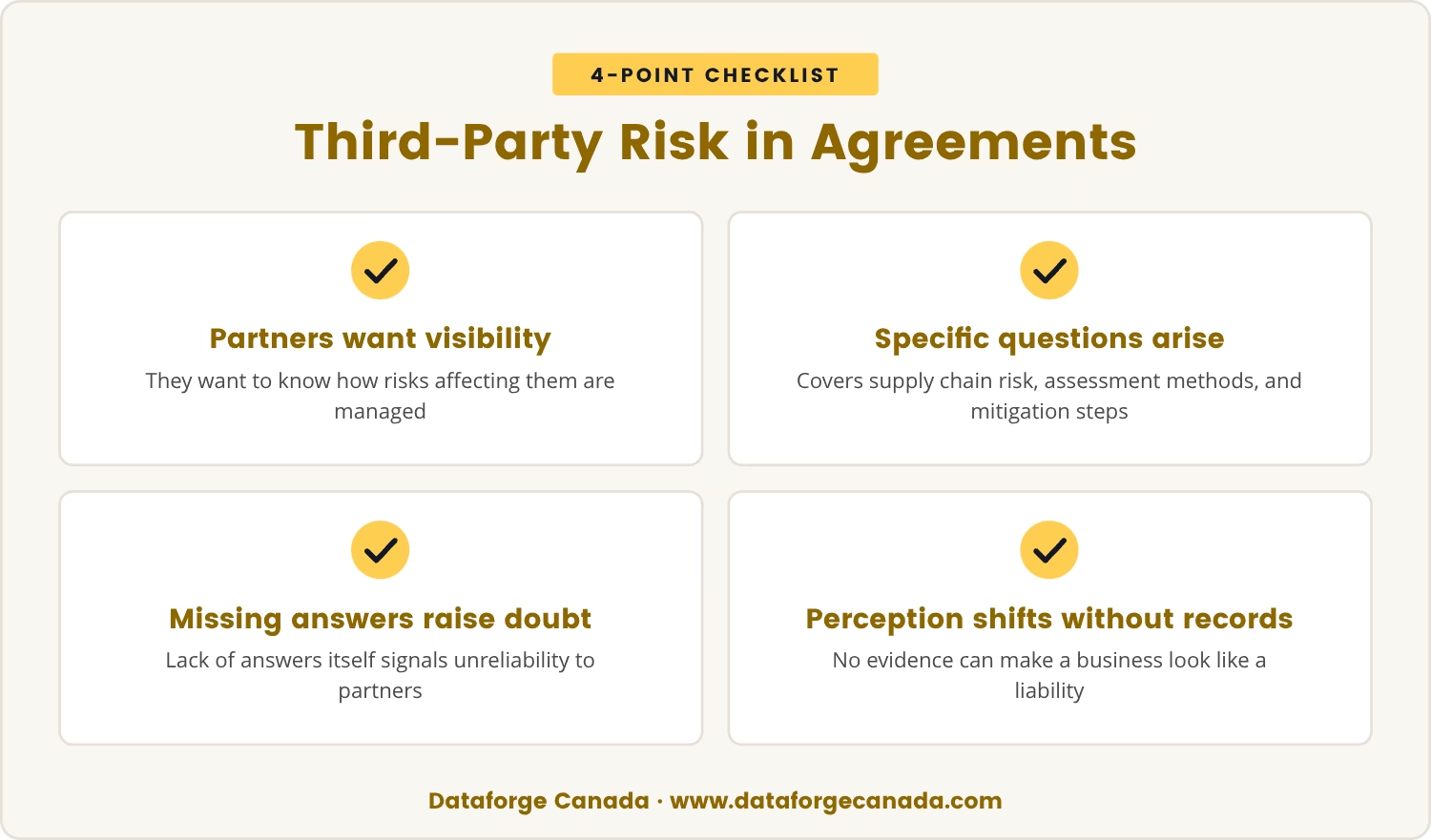
Third-party risk now gets its own line item in most contract reviews. Partners, suppliers, and clients increasingly want to know how you manage risks that could ripple out and affect them directly.
That means questions about supply chain risk, how risk gets assessed, and what mitigation steps actually follow an assessment. Arrive without answers, and the gap itself becomes a reason to doubt your reliability.
A partner might ask to see a risk register or evidence of a recent vulnerability assessment, for instance. No record to show them, and the conversation shifts—your business starts to look like a liability rather than a partner.
Documentation has become the basic admission price for many deals. Insurers and partners expect to see written policies, completed risk assessments, and evidence that someone reviews them on a regular schedule.
Without that paper trail, two things tend to happen together: insurance costs climb, and certain opportunities disappear before they're ever discussed, because insurers set premiums and coverage decisions directly off the strength of your risk management program.
In Vancouver, proof of risk management activity is turning into a standard part of due diligence rather than an occasional request, and as regulations tighten further, that expectation is only set to grow.
Before committing, partners and insurers tend to ask for a specific set of documents. The most common requests look like this:
A clear outline of your approach to identifying and managing risks, including who holds which responsibilities.
Documentation showing you've assessed your information systems for vulnerabilities and acted where action was needed.
Records of what was done to reduce or manage identified risks, from updated security controls to staff training sessions.
Plans explaining how operations would continue through a disruption, whether that's a cyberattack or a system failure.
Proof that risk management strategies get revisited and updated as new threats emerge.
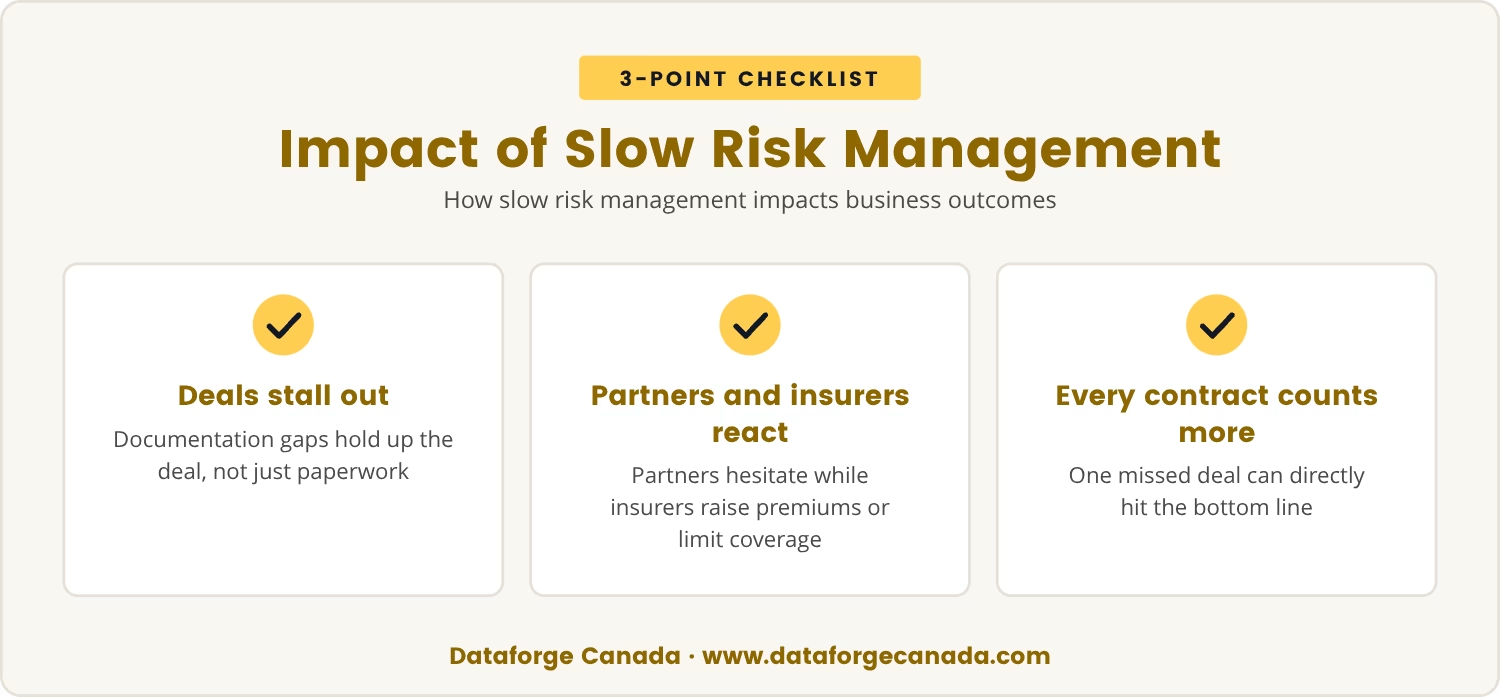
Gaps in that documentation don't stay contained to paperwork; they stall the deal itself. Partners hold back from committing, and insurers respond by raising premiums or narrowing coverage.
That delay reaches further than the single contract in front of you. Opportunities drift toward competitors whose risk management practices are already in order, and even once the missing information finally arrives, the lost time has already left a mark on the relationship and the trust behind it.
For businesses with 1-40 users, that kind of delay carries outsized weight. Each contract counts for more at that scale, so a single missed opportunity can show up directly in the bottom line.
None of this calls for an elaborate system. A handful of consistent steps is enough to meet what partners and insurers now expect:
Maintaining that documentation does more than satisfy the partner or insurer asking for it—it means risks get managed before they turn into problems in the first place.
That shift changes the posture of the whole negotiation: questions get answered on the spot, deals close faster, and costs that come from scrambling never materialize. In a competitive market, that speed is itself an advantage.
If you were asked today for your risk management documentation, would you have it ready? The answer could decide how quickly your next deal moves forward.

Many businesses with 1 to 40 users find themselves scrambling for risk documentation when a partner or insurer asks. At Dataforge Canada, we understand how easily a missing process can slow down your deals or raise your costs.
If you want to see how we approach risk management for small teams, or if you’d like to talk about your own setup, we invite you to start a conversation with us.
Lock in your rate for up to 2 years, with priority support and the flexibility to leave with 30 days’ notice during the first 12 months.
[.mspl-button-text]Lock in your rate[.mspl-button-text]
A risk management framework is a structured approach to identifying, assessing, and managing risks in a business. It supports clear policies and procedures so threats get a fast response and partner or insurer requirements get met without scrambling. Having one in place signals that risk is being taken seriously and that the business is prepared to protect itself.
A risk assessment deserves a review at least once a year, or sooner whenever the business or its technology changes significantly. Regular updates catch new vulnerabilities early and keep the overall risk management program working as intended.
Keep the documentation simple and clear: record each identified risk, the steps taken to manage it, and any changes made over time. Checklists or templates make updates easier to maintain, and records belong somewhere secure yet still easy to reach when needed.
Practical steps carry most of the weight: strong passwords, software kept current, and staff trained to spot phishing attempts. Even basic measures meaningfully reduce exposure to cyber risk, and an IT risk consultant can fill the gap when extra support is needed.
Continuous monitoring means regularly checking systems and processes for new threats or shifts in risk. It allows issues to get caught and addressed quickly, keeping the risk management strategy current even as the business itself evolves.